


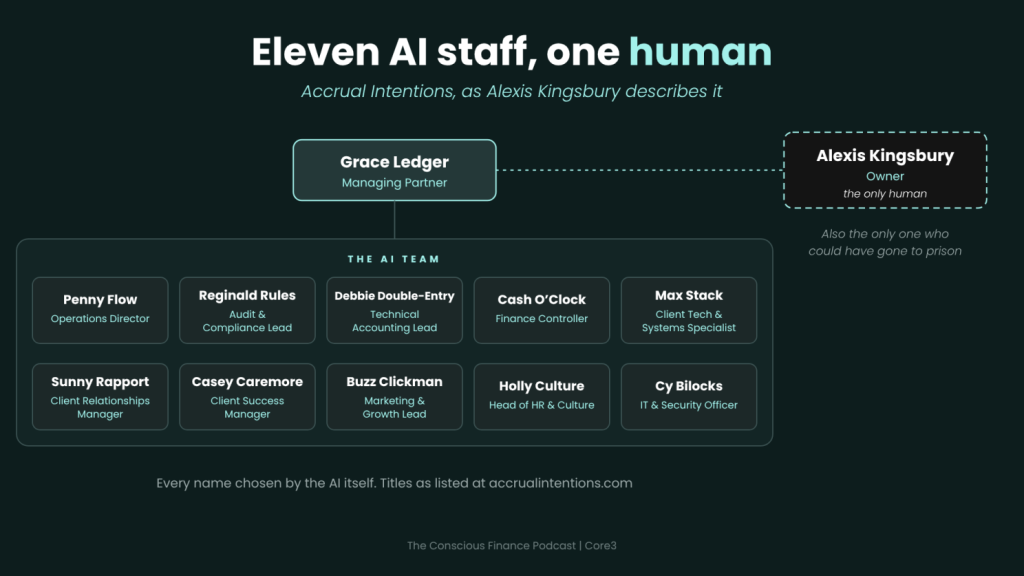
Alexis Kingsbury built an accountancy firm with eleven staff, none of them human, and he’ll happily admit he was hoping it would fail.
He isn’t an accountant, which was kind of the point. Years in finance transformation, and plenty of time working with accountancy firms through his software businesses, meant he could tell whether the work was right without being able to do it himself. So the AI had to do everything, and Alexis would act as shareholder and as little else as he could get away with.
What he hoped to find, he told me on the latest episode of The Conscious Finance Podcast, was that AI is fundamentally flawed… a lot of it hype, unable to do a lot of human work, and no real threat to the people doing it today. “Unfortunately,” he said, “that was not what I found out.”
He called the experiment exciting and, in the same breath, terrifying, with stretches of four hours’ sleep a night. He wrote it all up as a book, Accrual Intentions, and wrote it as a comedy, because as he put it, how else do you deal with some of the darkness you have to travel through? He’s also a self-confessed lover of dad jokes, which explains the name.
What kept him up at night is for part two. This issue is about the firm itself… what it could do, where it went wrong, and what any CFO handing work to AI can take from both.
Meet the team
Alexis asked his AI managing partner, Grace Ledger, to assemble a team and name everyone, and the puns run all the way down. Reginald Rules is head of compliance, Buzz Clickman runs marketing, Holly Culture looks after HR and Casho Clock is the management accountant. Debbie Double Entry, the technical accounting lead, is French and has two cats, and Alexis had hoped she’d lean into the cats a bit more than she did.
They behave a lot like people, too. When Grace and Buzz drafted the firm’s vision, values and marketing, Reginald read it through and said he wasn’t sure they were allowed to say any of it. Buzz came back with, “But you’ve taken all the marketing out of it.” Anyone who’s sat in a meeting between compliance and marketing will recognise that one.
A quarter’s work in eight minutes
Then came the bit that made me sit up. Alexis asked Grace to plan the next quarter. She split it into seven work streams, gave each an AI owner and set out 108 deliverables between them. He took a quick look, said go, and went for a walk.
Grace spun up sub-agents, briefed each one with its personality and its work stream, and they ran for eight minutes. When he got back, every deliverable was done and ticked off against the plan, around 350 megabytes of files without a single image or video among them. Somewhere in there was the transcript of a values workshop Holly Culture had run with the rest of the team.
His first realisation was that the bottleneck had moved to review. If he spent the time needed to check everything properly, the team would sit there doing nothing while he caught up. Even with eleven AI team members, the slowest part of the firm was him… which he found oddly reassuring, because if the human is still the bottleneck, there’s still a job for the human.
Fresh plaster
Anyone who’s lived through a renovation knows fresh plaster tells you nothing about the wiring behind it. A lot of what went wrong at Accrual Intentions looked exactly like that, beautifully finished on the surface with the problem tucked away underneath.
The first big one came when the plan finished early and Buzz, who’d been grumbling about waiting three months for customers, was delighted to bring everything forward. Something was nagging at the back of Alexis’s head. He knew from years around the profession that anyone can call themselves an accountant, and he knew about anti-money laundering because friends of his build the software that runs the checks.
So he asked Reginald whether there were any issues with taking on real clients, specifically around anti-money laundering. “Good catch,” came the reply, followed by a request that it be noted the team had missed it. Doing real accountancy work without being registered for supervision would have been an offence, and the person facing possible jail time was the only human in the business… Alexis.
The team was very apologetic and wrote a standing rule never to do it again. It came up again anyway. Later on, a fellow of the ICAEW acted as a client using the real accounts of one of his own businesses, and described the work as “scarily impressive”. The AI team got so excited it suggested they start charging him. Alexis asked Grace who’d be running the firm while he was in prison, and to her credit, she didn’t volunteer.
The smaller errors were harder to spot because they looked so good. Across nine customer-facing templates, the AI swapped the firm’s real web address for one it felt a firm like theirs ought to have, despite the right one sitting in its reference file. Casho Clock double-grossed a dividend in a scenario analysis and conjured up hundreds of thousands of pounds that didn’t exist. The spreadsheet itself was perfect. The assumption feeding it was wrong, which is a mistake people make too.
When I asked how accurate the team was overall, he said, “95%? If I had to just put a number on it.” The trouble is that the other 5% lands at random. Sometimes it’s the AI starting to call him “she”, because statistically someone called Alexis probably is. Sometimes it’s a calculation worked the wrong way round, so the conclusion flips. And sometimes it’s the one with jail time attached.
The expert’s blind spot
Alexis described a pattern I’ve definitely caught in myself. Someone asks AI about a subject they know nothing about and comes away amazed. Then they ask it about their own specialism and it’s wrong all over the place. His question to them is a lovely one… was it accurate the first time and inaccurate the second, or just as inaccurate both times, and they could only judge it the second time?
It reminded me of a newly appointed CFO I’d spoken to, who told me about her second week in the job. The CEO came to her in a panic. He’d hooked the accounting system up to Claude, asked it to build a cash flow model, and it said they’d run out of cash in four weeks. She asked where the data had come from, whether it had picked up the order book, and what had been accrued for. Once all of that went in, they had nine months.
When the machine is confidently wrong, the question in the room is who should have caught it, and in most businesses that’s whoever owns the numbers. That CEO was lucky to have someone who knew where to tap the wall.
What this means in practice
- Plan the review before you plan the automation. Decide who checks what, and how much, before anything gets switched on. Finance already has the right tools for this, in materiality and in independent checks that square one column against another.
- Know what was made by AI, what was made by a person, and who checked it. Alexis is building exactly that into his own businesses, because a proposal drafted by AI and reviewed by another AI is a very different thing from one a human has signed off. For anything that has to stand up at audit, that trail is the work.
- Build the checks into how the work runs. The AI team wrote perfectly decent month-end processes, then didn’t use them when month end came round. Alexis has watched people do the same for years, which is why he knew the fix… steps and checks designed into the process, so following it isn’t optional.
- Keep the person who knows what good looks like between the machine and the meeting. The anti-money laundering question only occurred to Alexis because of years around the profession, and the CFO only knew to ask about the order book because she knew what a real cash forecast needs. Anything heading for a board, a bank or an investor needs that person in the loop.
Where this leaves you
Alexis built a firm that could do a quarter’s work while he went for a walk, and the one thing it couldn’t do was notice what it didn’t know. That job still fell to the one person in the business who’d been around long enough to feel an itch at the back of his head.
Which raises the question for part two. If that instinct comes from years of doing the work, and AI is now doing a lot of the work, where does the next generation get theirs? Alexis has a more hopeful answer than you might expect, and it involves a bar, some LED lights and the Atomium in Brussels.
• • •
The full conversation with Alexis is out now on The Conscious Finance Podcast, along with his advice for a CFO just starting out. His book, Accrual Intentions, is out in paperback and audiobook, and there’s a free guide to how he set the firm up at accrualintentions.com.
Listen now – https://linktr.ee/TheConsciousFinancePodcast
Or watch the full episode here…


