


The spare-time builders
A client recently asked me to find an ‘AI wizard’ in FP&A. Its something which is nearly impossible to qualify from a CV.
Then… halfway through a candidate interview last week, the CV stopped mattering so much.
The day job was all there… Senior FP&A, good businesses, solid numbers. The usual conversation. Then I asked what he’d been doing with AI, and the whole call changed gear.
Because in the evenings, this man builds. He made a trading platform, in Claude code, that runs without him touching it. A Supabase SQL database in the backend keeping tabs on all trade history, and automated alerts via Telegram telling him what trades are worth making. He’d taught himself the lot, mostly because he couldn’t leave the problem alone, but also because he’s naturally tech curious. Most people at his level are chatting to an LLM and calling it AI experience. He’s several floors above that.
And his employer has almost no idea because they don’t encourage AI experimentation, or give their teams the freedom to build.
This is the pattern now. The most valuable new skill in finance is being built at kitchen tables, after hours, by people whose day jobs haven’t asked for it yet.
What one market map showed us
To put some numbers on it… last month we mapped one region of the UK for a single commercial finance role for a mid-market D2C business. A proper deep dive, business by business, sector by sector, checked against filings.
224 businesses of the right sector and size. Inside them, 167 commercial finance people but only 79 were operating at the level this role needed them.
Then the last filter. Who… out of those 79… can also build with AI, or shows the unmistakable mindset of someone who will?
It was one or two.
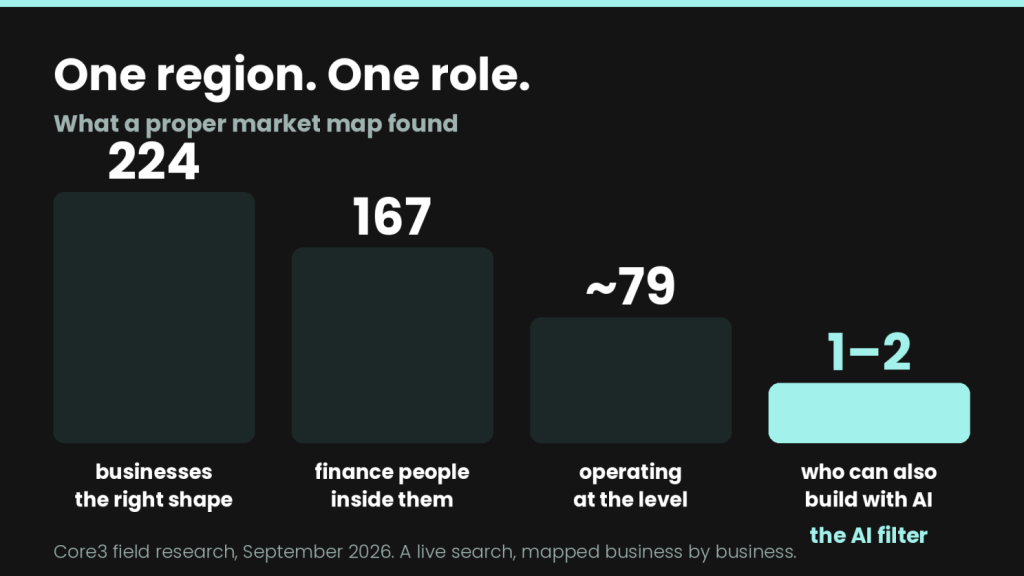
The 79 exist, and they’re good. The combination is what’s nearly empty… finance judgement at level, plus the appetite to build.
The AI in Finance workshops we run tell the same story from the other side. Over a thousand finance leaders have now joined our AI in Finance series, and I survey them every month. Fewer than 5% have AI properly wired into their team’s workflows. That number is growing, but its still small.
Why the skill hides at home
Talk to enough of these people and the blocker becomes obvious… it’s permission.
You can find really good finance business partners who experiment constantly with AI in their own time. Their business just hasn’t given them the freedom to bring it inside. No sandbox, no mandate, a systems team with bigger fires to fight. So the capability stays invisible at work and grows at home.
The workshop pattern rhymes with it. Someone comes to a session, leaves buzzing, and for forty-eight hours it’s the most exciting thing they’ve seen. Then everyone gets back to month end.
There’s a mindset split underneath this, and it predicts almost everything. Two ways of thinking about AI in finance are doing the rounds. Ten times faster… same outputs, done quicker, headcount saved. And ten times better… reimagine what the outputs even are, now that a model can run a thousand scenarios overnight and hand you intelligence you’d never have dreamt of asking for.
Most CFOs default to faster, because faster is easy to put in a business case. The spare-time builders are ten-times-better people by instinct. They built because the problem was interesting, long before anyone mentioned a business case.
That instinct is the thing you’re actually hiring for.
How to interview for it
If you’re looking for AI skills, there are four changes worth making before your next finance hire….
- Ask what they’ve built… including at home. The spare-time project is often the tell. It shows appetite no certificate can, and the ones who light up describing it are showing you the mindset, live.
- Set a task and allow AI. Brief a real piece of work and say the words: ‘use as much or as little AI as you want.’ Then watch what they do. An hour of that teaches you more than three competency interviews.
- Stop writing ‘two years of AI experience’ into the spec. Dusting off the job description from three years ago and adding AI to the skills list misses how fast this is moving. Almost nobody has the experience yet. Plenty of people have the mindset.
- Keep the human gates. In a role like this, someone who can build but can’t read a room, challenge a director or hold their judgement under pressure is still a no. Capability opens the door, but judgement and fit decide who walks through it.
The bit about the ones you already have
If one or two people in a whole region can do this, the ones who can are starting to know it. AI skills at this level already come at a premium, and the premium is heading one way.
So there’s a retention risk hiding in plain sight. The builder with no backing gets frustrated. They’ve shown someone what’s possible, been politely ignored, and gone back to building at home. Those are exactly the people who take a call when a role promises them real freedom to flex their AI muscle.
Finding those people is literally my job at the moment (lucking our AI workshop community has a good handful!). So take this as fair warning… if you have a spare-time builder in your midst, give them a reason to build at work before someone like me gives them one somewhere else.
Where this leaves you
Every CFO I speak to at the moment wants to hire this capability, but very few have gone looking for it in the team they already run.
So… before the next job spec gets written, try one question at your next team meeting. Ask who’s been experimenting with AI at home. Then watch whose eyes come up from the table.
Who on your team would build in their spare time… if you gave them a reason to do it at work?
Thanks for reading,
Leo
Leo Hewett, Founder of Core3 | CFO search & finance recruitment | Scale-ready finance teams | AI-enabled finance transformation | Host of The Conscious Finance Podcast


