


Picture the scene…
You’re three weeks into a new CFO role at a 250-person business. The team you inherited is solid. An experienced FC who knows where every body is buried. A management accountant who works late. Two analysts. An AP clerk. A bookkeeper. Plus a fractional treasury contractor for the trickier stuff.
Eight people, give or take. A cost line you can defend. Month-end runs to plan. The board pack lands on Friday. The numbers are right.
So why does it feel like the function you’re running today is the same shape as the team you joined as a newly qual in 2014?
That’s the question I’ve been hearing from CFOs more in the last six months than I have in the previous five years. The tools have changed, but the roles haven’t. And the gap is starting to make people uncomfortable.
What the data says
McKinsey research suggests around four in ten CFOs report that 75% or more of their finance processes are still manual. Most teams still spend the majority of their time producing numbers rather than interpreting them. AI has been bolted on (a Copilot here, a forecasting tool there), but the underlying team structure looks largely unchanged.
Gartner’s projections sit in the background of every conversation I’m having at the moment. By 2030, on their estimates, around 15% of day-to-day finance decisions will be made autonomously. 70% of finance functions will be using AI for real-time decision support. Middle-management roles in finance could shrink by more than half.
That’s four years away. Not ten.
Push the timeline out to 2036 and the picture changes even further. The transactional layer disappears. The middle hollows out. The strategic and partnering edge grows. The function gets leaner and more specialised at the same time.
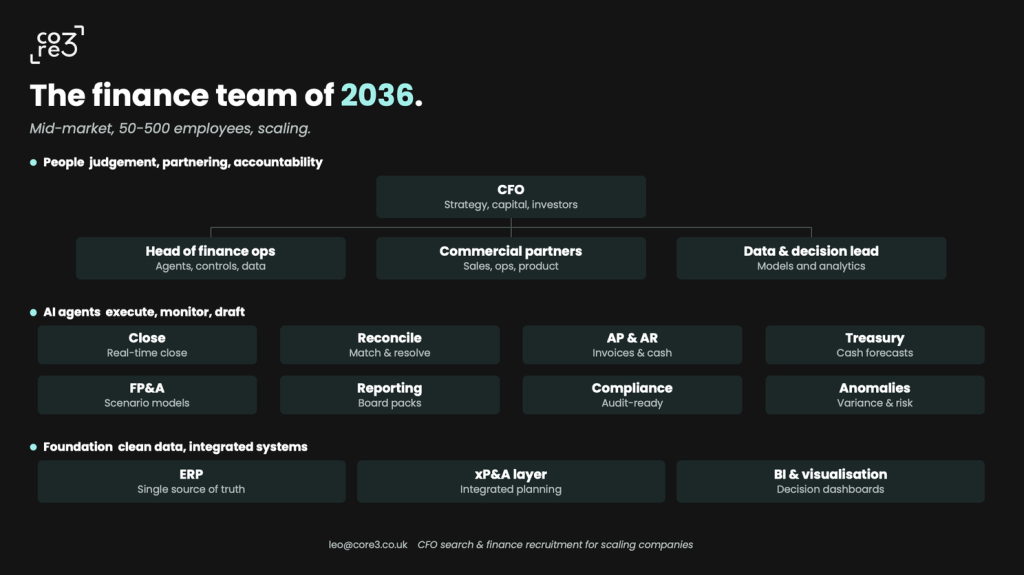
The shape of it
This is the picture I’ve ended up with after pulling at the thread for a while…
The 2036 finance team in a 250-person business looks something like four humans working with a stack of AI agents.
A CFO who’s grown into the role of value architect. The person on capital, commercial strategy, and the relationships that matter when the forecast wobbles.
A Head of Finance Operations who orchestrates the agent stack, owns data integrity, and runs the controls environment.
A commercial finance partner, sometimes two, embedded with sales, operations, and product. Translating, partnering, challenging.
A data and decision lead who owns the analytics stack, the models, and the way decisions actually get made.
Underneath that team sits the agent layer, doing the work that today takes six accountants and a controller. Continuous close. Reconciliations. AP and AR. Cash forecasting. First-draft reporting. Compliance monitoring. Scenario modelling.
And beneath everything sits the data foundation. A single source of truth in the ERP. An integrated planning layer. A BI layer where decisions actually live.
That foundation is the bedrock to all of this working properly. Stack a hundred AI agents on top of bad data and all you’ve done is amplify the mess. The agents work faster, but they’re working from the same broken source. Most of the businesses I see won’t reach the 2036 picture because they haven’t fixed the plumbing underneath. The shape on the org chart is the visible bit. The plumbing is what makes it work.
What stays human
The shape isn’t the most interesting part of the picture, though. The more important question, the one that actually shapes the hiring decisions you’re making this year, is what does this mean for the humans on the team?
The instinct most CFOs are showing right now is to treat AI as a productivity layer. Faster close. Quicker reports. Tidier reconciliations. Same job, less time.
That’s not what the next ten years are going to be about.
The job changes shape entirely. The transactional work falls away. So does most of the middle-management work that exists to check the work below it. What’s left is the work AI can’t do.
Judgement when the data is uncertain.
Translation between finance and the rest of the business, when operations doesn’t believe the numbers because they don’t match what they see at the coal face, when sales tells a different story, when the founder changes direction on a Tuesday.
Trust with the board and the investors when the forecast wobbles. Difficult conversations the agent can’t have. Standing behind the decision when the model’s confidence interval is wider than anyone wants to admit.
This work was always the real job. AI just removes everything else and exposes it.
Which means the skill stack supporting that work is not the skill stack that filled the analyst job description ten years ago.
Real AI fluency. Not the occasional ChatGPT query, but a working understanding of what these systems can and can’t do, where they break, and how to design work around them. Data literacy as the foundation. Deep finance expertise, because you can’t audit what you don’t understand. Storytelling, because translating numbers into decisions is the daily work. And comfort with ambiguity, because the model will be wrong sometimes and you’ll need to back yourself.
That mix is rare. And it’s getting more valuable.
The hiring question
The trap I see most often is hiring for the team you have, not the team you’ll need. Filling the open management accountant seat with another management accountant. Adding headcount that looks like the headcount you’ve already got. Building a finance function for the work that’s about to disappear.
The CFOs I see getting this right are doing two things differently…
One, they’re slowing down on the operational hires. Not stopping. Slowing. Asking whether the seat needs filling at all, or whether the data and systems work needs doing first. Sometimes that means leaving a role open for three months while the foundation gets fixed.
Two, they’re hiring on a different profile. AI-fluent, commercially curious, comfortable in ambiguity. Less interested in someone who can run the close than someone who can change how the close gets run.
Neither is comfortable. Both create awkward conversations with the board and the rest of the leadership team. But they’re the right call if you’re trying to build a finance function that still makes sense in 2036.
Where this leaves you
The team you build now is the team you’ll lead in 2036.
So when the next finance hire lands on your desk, try a different question. Forget ‘who fills this seat?’ for a moment. Ask ‘is this even the right seat to fill in three years’ time?’
That’s a harder question. It’s also the one your future self will thank you for.
If you’d like to think through what this looks like in your business. Where to start, what to leave alone, what to hire for.
Drop Leo a note at [email protected]. We’re spending most of our time at Core3 on this exact question at the moment with CFOs in scaling mid-market businesses. Happy to walk you through what we’ve seen work, and where the common traps sit.


