


Imagine the CFO you wanted to become when you were 24.
The person you watched handle a board meeting where nothing was going to plan and still walked out with the room behind them. The one who picked up that the forecast was off before the analyst had spotted it. The one who knew, when the deal got rough, what the founder needed to hear and what the bank needed to see.
That person didn’t get there from a textbook. Or a qualification. Or an AI tool.
They got there from 80 month-ends. From watching three CFOs they respected handle a covenant breach. From getting the variance analysis wrong eight times before they stopped missing the same thing.
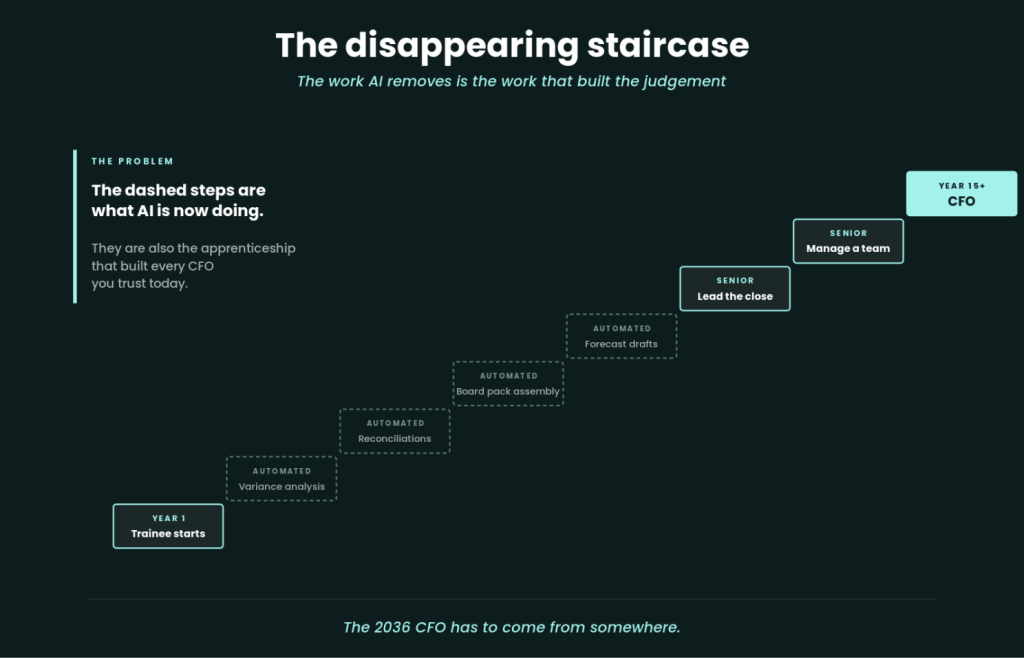
A staircase. Long, repetitive, occasionally humiliating. But it built something.
Now we’re being asked to design a finance function for 2036 that removes most of the steps.
The question nobody’s answering
A couple of weeks ago I wrote about what the mid-market finance team of 2036 looks like. Smaller, leaner, agent-driven. Most of the transactional work gone. The humans focused on judgement, translation, and trust.
A few people came back with the same question…
If the agents do the work juniors used to do, where does the next generation of senior finance leaders come from?
It’s the question most of the AI-in-finance content avoids. The futurists skip it. The vendors won’t touch it. And the data suggests it’s no longer hypothetical.
A Stanford study last year (you may have seen it as ‘Canaries in the Coal Mine’) tracked payroll data across millions of US workers. In the most AI-exposed jobs, employment of 22-25 year-olds fell 6% between late 2022 and July 2025. Same roles, 35-49 year-olds, employment grew over 9%.
Finance and accounting were named among the earliest affected sectors.
What’s really happening
The pattern isn’t AI ‘removing jobs’. That framing’s too neat.
What’s happening is more subtle, and more worrying. AI is removing the work that built the judgement.
The variance analysis a 24-year-old used to run by hand. The reconciliations that taught you which suppliers were chaotic and which were precise. The board pack assembly that showed you how leadership actually thought, long before you sat at the table. The five drafts of a forecast that taught you which assumptions held and which collapsed under pressure.
That was never busywork. It was the apprenticeship. The way tacit knowledge passed from one generation to the next.
Microsoft researchers have a name for what happens when juniors lean on AI before they’ve built their own foundation. They call it AI drag. MIT researchers, separately, have measured what they call cognitive debt. Reduced retention. Shallower understanding. Skill that cracks under pressure.
Plenty of juniors are still being hired. They’re just not building the underlying judgement.
The staircase is still there in form. It just doesn’t go anywhere any more.
Why this is harder in the mid-market
The Big 4 and corporates will get this right eventually. They’ve got the scale to run apprenticeship programmes, fund 12-month mentorship tracks, and treat training as a measurable deliverable.
Mid-market businesses don’t.
A 250-person PE-backed business hires one or two trainees a year, if that. Most don’t have a graduate scheme. The two finance managers who would have grown into the next FC role joined six years ago, on the back of a trainee model that was already eroding then.
The future talent crisis thats brewing is less about junior unemployment. It’s senior FDs in their 50s with no obvious successor inside the business. PE houses relying more heavily on interim CFOs. Mid-market companies hiring external because there’s nobody internal who’s ready, even after eight years.
That’s not a 2036 problem, the early signs are happening now.
The provocation worth sitting with
The version of the 2036 finance team most consultancies are pitching is four humans plus eight agents. Smaller, cheaper, faster.
The version that probably works is four humans, eight agents, and two structured early-career apprentices. People on the team to learn, write the prompts, verify the outputs, challenge the agent stack, and grow into the senior partner and CFO roles in ten years.
Six people, not four.
The cost may look worse this year, but it looks materially better in five years, when every other PE-backed business in your portfolio is struggling to hire a finance director who’s seen anything and you’re ahead of the curve with succession planning.
The institutes are moving in the right direction. The ACCA redesign for 2027 weaves AI and data through the qualification. ICAEW launched the new ACA in September 2025 with a heavier focus on tech and ethics. Both will help.
Neither solves the on-the-job problem. A qualification doesn’t replace the learning surface that’s being automated away.
What this means in practice
A few things worth thinking about this year.
One. If you’re running a finance team in a scaling mid-market business, the temptation to defer the next trainee hire is high. The role is expensive, the payback is long, and AI can plausibly cover the work. Its worth pausing on that. The cost of not hiring shows up in 2031, not 2026.
Two. If you do have trainees in the team, the brief has changed. They’re verifiers now. Prompt-builders. AI-output auditors. Their job is to challenge what the system produces, not feed it.
Three. Mentorship has to stop being side-of-desk. Senior people need explicit time in the week to train the juniors. Measured, funded, accountable. Not ‘if there’s time’.
Four. The hiring profile for your next mid-level finance role probably needs a rethink. Less ‘three years of Big 4 audit experience’. More ‘three years of finance experience plus genuine AI fluency plus comfort with ambiguity’. Those people are rare. They will get more valuable.
The thing about staircases
The CFO of 2036 doesn’t appear in 2036.
They’re already in the building. The second-year trainee you’re deciding whether to invest in. The finance manager you’re choosing whether to stretch. The FP&A analyst you’re either developing or slowly replacing with an agent.
If we automate the steps out from under them now, in 2036 we’ll be staring at the same problem with no quick fix.
Nobody’s coming to rebuild the staircase for us. It has to be built deliberately, into the design of the finance team itself.
The 2036 CFO has to come from somewhere, right?
Want to talk about it?
We spend a lot of time in conversation with CFOs and PE investors about exactly this. What does the team need to look like in 2026, 2028, 2030? Where are the gaps already showing? How do you build a finance function that still produces senior leaders in seven years?
If you want to walk through what we’ve seen work, and where the traps are, feel free to reach out…
Leo Hewett. Founder, Core3.


