


A young finance manager, a few years into his career and working in the US, had a standing invitation to the operations team’s morning meeting. Buy most mornings… he didn’t go.
He’d never quite worked out what his role was in there, and a small voice kept suggesting they probably didn’t want him in the room anyway. So he stayed at his desk with the numbers, which is a very comfortable place for a finance person to be.
That finance manager was Anders Liu-Lindberg, telling the story against himself on the latest episode of The Conscious Finance Podcast. He spent thirteen years at Maersk, most of them in business-facing roles, and by his own reckoning it took him about ten of those years to get properly good at business partnering. He’s spent a big chunk of the time since, first building a business partnering institute and now in the finance practice at Implement Consulting Group, trying to get other finance people there in two or three.
I found that oddly reassuring…. If the man who’s spent years teaching finance people to walk into those rooms once skipped one himself, there’s hope for the rest of us.
The last article about my interview with Anders was about ambition, and whether your AI plan is aiming for ten percent faster or ten times better (Jeremy Utley’s fork, and a very useful one). This one is about the people. Whichever version you choose, somebody has to do the work that’s left once the machines have done theirs… and that somebody looks a lot like the finance manager who wasn’t sure he was wanted in the meeting.
From pyramid to diamond
Anders sees most of today’s finance teams as a pyramid. A broad base of entry-level, transactional work, accounts payable, accounts receivable, the processing that keeps the lights on, with a narrower band of specialists above it and a small top.
The team he expects to see in five years or so, and he was careful to say he doesn’t know exactly how long it’ll take, looks more like a diamond. The transactional work is still there, it just runs mostly automated, overseen by a controller who understands both the processes and the technology, and who picks up the exceptions. The middle is where it widens. Experts, each one the human in the loop with a handful of agents around them doing the legwork, whose job is to work out what it all means for the business and bring that judgement into conversations about performance and strategy.
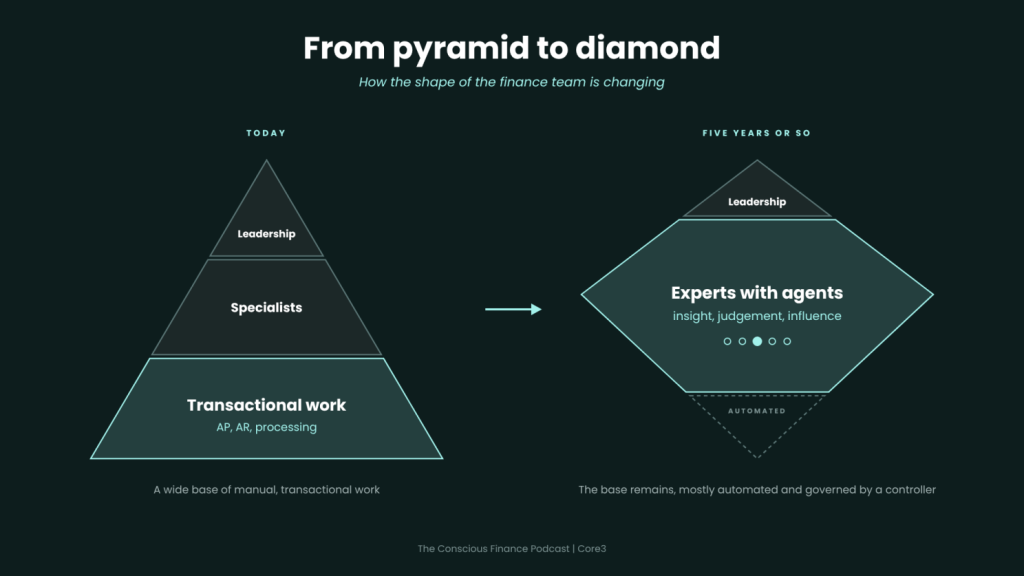
He was candid about how familiar the idea is. The vision, he said, is much the same one finance has been promising itself for years, and the difference now is that it’s really happening.
He also had a line about the people in that middle layer that I suspect most finance teams would recognise. Ask anyone in finance today and they’ll tell you they’re far too busy for anything new. Put AI in their hands, Anders reckons, and the answer changes to something like… right, now I’ve got time for all the things we’ve always talked about doing.
A very small base
I put a worry to him that I hear from CFOs a lot. A diamond has a very small base, and the base is where most of today’s finance leaders learned the job. The routine month-end work was boring, but it built the judgement the middle of the diamond now depends on. Shrink that layer and where does the next generation learn?
His answer was more hopeful than the question. The real-world training ground is going, he agreed, and it’s being replaced by a virtual, AI-driven one. He mentioned, from memory, a Wall Street Journal story about KPMG building that kind of simulated training environment, and while I’d want to read it before quoting it as gospel, the direction makes sense. The juniors don’t disappear either. Implement’s own CEO, he said, has been clear that they’ll still hire junior consultants, just with different expectations of them, and he thinks finance will go the same way.
My own hunch, which I shared on the episode, is that the agentic layer becomes the place juniors cut their teeth. Building the agents, improving them, and checking their output against what’s really in the ledger, with a financial controller beside them teaching them what good looks like. It won’t build itself, mind. Someone has to design that apprenticeship on purpose.
Anders was blunter about the old way. Most people, and younger generations especially, go to work because they want to have an impact, and as he put it, “you don’t have a big impact if you’re doing T accounts and debit credits all day long.”
The middle is already on your payroll
At the end of the episode I asked the question I keep asking CFOs… When the prepping and the doing go, what’s left is insight, the ability to influence and the ability to translate what the numbers mean. Have you got a team that’s fit for that?
Anders didn’t soften it. Most finance functions, in his view, don’t have that team yet, “but then you’ve got to make them fit.” You can’t swap everyone out for new people, because the ready-made version barely exists in the market, the competition for the few who do is fierce, and you’ll end up overpaying. “You know that, Leo,” he added, which was a fair cop.
He was upfront that his firm sells finance development, so he would say that. I’m a recruiter, so in theory I’m meant to argue the opposite, but I didn’t. Hiring to close a gap of one or two people makes complete sense, but hiring to close a massive gap, in his words, isn’t possible. If you map the skills in your team properly, a lot of the distance can be closed with coaching and development, and I think the learning and development side of finance is going to matter enormously over the next five years.
Which brings us back to the morning meeting. Anders’ view is that most finance professionals already have the technical skills. The hard part is behaviour… building relationships with people you might not naturally strike up a conversation with in a supermarket. About ten years ago he made networking a “must-win battle” for himself, threw himself at it, and got good at it. He still doesn’t like it. Enjoying it, in his view, is optional, as long as you want to get good at it.
That’s most of the middle of the diamond, really. People who already have the numbers, and need a reason and a bit of a push to take them into the room. With the right tools from the start, Anders reckons the ten years it took him can shrink to two or three.
What this means for the team you’ve got
- Draw your team as it stands and be honest about the shape. How much of the week sits in the base, and who is already doing some middle-of-the-diamond work, even if it isn’t in their job title? Those people are your starting point.
- Hire for the one or two gaps that really can’t be grown in the time you’ve got. Be specific about which those are before anyone dusts off a job spec.
- Build the new apprenticeship deliberately. If the junior’s job becomes building and checking the agents, pair them with the controller and make “what good looks like” something the controller teaches out loud, week by week.
- Find your own version of the morning meeting. Pick someone capable who tends to stay at their desk, send them to the operations or sales meeting, and give them one job when they get there… a question to ask, or a number to explain in the room’s language. Then do it again the following week.
Where this leaves you
Anders didn’t stay at his desk forever. He worked out that he needed to be in those rooms, and once he wanted to be good at it, he got good at it, slowly, with nobody showing him how.
The finance team of the next few years needs a lot more people who can do what he learned, and the market won’t have enough of them for sale. Which means some of the most valuable people in your future team are already on your payroll, sitting at their desks, waiting for somebody to give them a reason to walk into the meeting.
• •
The full conversation with Anders is out now on The Conscious Finance Podcast cast. Alongside the diamond, he walks through why finance usually loses a room in the first five minutes, his five-step structure for being heard, and why the forecast should be led by reality while the budget carries the ambition. A little under an hour, and I came away with a notepad full of things to steal.


