


‘We can’t really do anything with AI until the data’s sorted.’
Some version of that sentence has come up in almost every AI in Finance conversation I’ve had for two years. It gets said calmly, the way you’d state a fact about the weather, because for a long time it was true, and because someone credible said it first.
And it’s reasonable, right? The master data’s a mess, the ERP doesn’t talk to the planning tool, and three systems hold a version of the customer that none of them agree on. So the sensible order of operations looks obvious. Fix the foundations, then automate on top of them. Every sensible adviser has said it, including me, in this newsletter, about a month ago.
It’s good advice, but its also cost a lot of finance teams about eighteen months.
What the advice leaves out
The foundations project has a start date, a budget and a steering committee. What it doesn’t have is a finish date, and it never has. Ask anyone who’s been through an ERP implementation what the original timeline was and watch their face.
Meanwhile the CFO who said ‘not yet’ in early 2025 is eighteen months into the wait, and somewhere down the road another finance team has turned a five-day process into an afternoon with an exported file and a model.
Gartner published its 2026 view on this in May, from a March survey of 204 finance leaders. Two of the findings sit next to each other. Among finance organisations that have adopted AI, 66% report greater efficiency and productivity as a top benefit, so the gains are real and they’re arriving. But 63% said AI implementation went slower than expected in 2025.
Slower than expected. That’s the tax on waiting for perfect conditions, and it’s being paid by the people who did exactly what the advice told them to do.
Back to the house
Regular readers will have met our house before. It’s a 1910 renovation project, it’s been under scaffolding for the best part of a year, and I’m going to use it again because it’s still the most useful example I’ve got. The roof came off and went back on. Everything costs roughly double whatever anyone tells you.
The one thing we never seriously considered was moving out until it was finished. You live in it. Some rooms are lovely, some are dust, and the kettle works, so you get on with it.
Finance data is the same house. A month ago I wrote ‘electrics before decorating, data before agents’, and I still mean it, because a hundred agents stacked on bad data just amplify the mess faster. The systems work needs doing and it will take as long as it takes. But nothing about that requires the team to stand outside in the rain waiting for the plasterer.
You can export a file today. Point a model at that file, with the right instructions and proper checks around it, and it’ll do work that used to take a week. There’s no integration project in that sentence. Its a download and an upload.
Nobody’s calling that elegant, and it’s a long way from the end state. But it does put hours back on a real person’s desk this month rather than in the autumn of next year.
The blocker moves
The hours are the small prize. What the exercise exposes matters a good deal more, and it took me a while to see it.
Somewhere around the second week, the blocker stops being the data and turns into the person sitting in front of it. Who on this team can look at a plausible, beautifully formatted output and spot the assumption that’s creaking? Who’s curious enough to keep taking the process apart? And who, after fifteen good years, would rather be left alone to run the close the way it’s always been run?
That last one is a fair reaction, by the way. This is uncomfortable, and pretending everyone’s thrilled helps nobody.
But that’s the real audit, and it can’t happen while everyone’s waiting for the systems project to land.
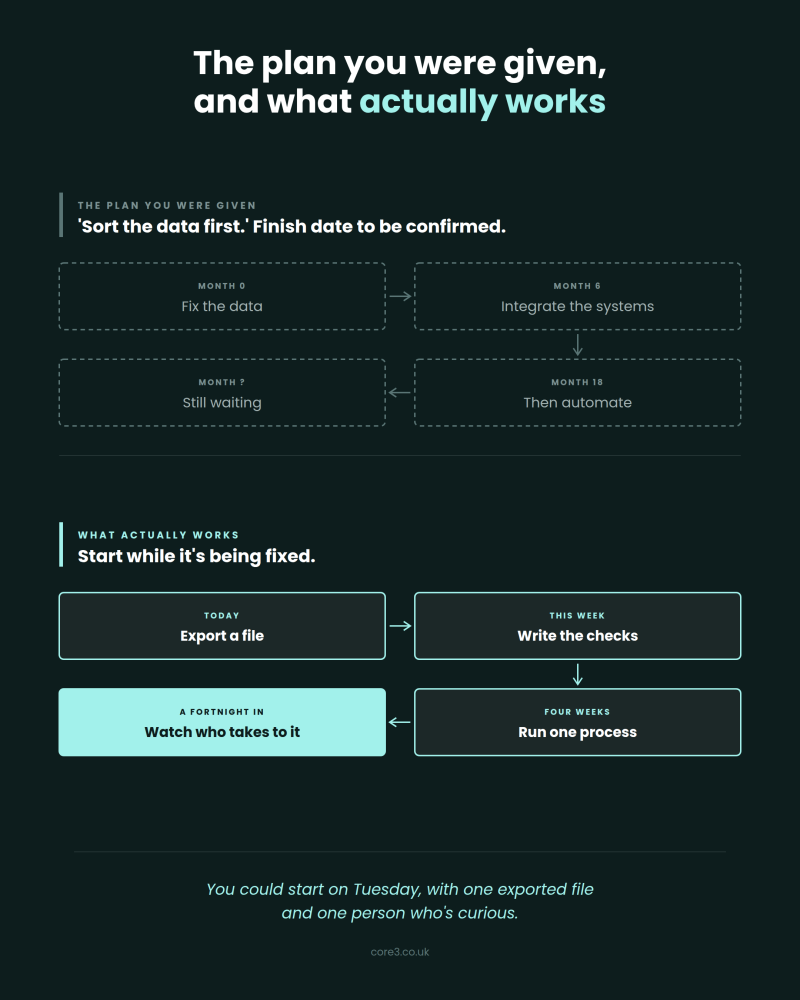
Which is why the sequence most teams get handed runs the wrong way round. Start small, start messy, and let the work tell you who builds, who validates, and where the gap sits. Then you know what you’re hiring for, and the systems investment gets designed around a team that actually exists.
What this means in practice
One. Pick one process this month that doesn’t need a system to change. Board commentary, a reconciliation, a first-draft forecast. Export, upload, run it properly, then compare it to what a person produced. One process, four weeks.
Two. Write the checks before you write the prompt. Traceable formulas and a documented source for every assumption. A marketing team can live with the odd hallucination in a first draft. Somebody will ask you where a number came from eleven months after you produced it, and the answer needs to exist. (The ICAEW FACETS framework is great a great place to start).
Three. Keep the systems roadmap running exactly as it is, same pace, same budget. This is what you do while the foundations are being laid. The teams that get it wrong pick one and drop the other.
Four.Watch who takes to it. The person who rebuilds the thing twice because the first version wasn’t good enough has just told you something a competency framework never would, and they’re could be your next AI in Finance champion.
Where this leaves you
The data will never be finished. That’s just what data looks like in a growing business, where there’s always another acquisition, another product line, another system somebody bought without asking.
So the better question is whether you’re willing to work in the house while it’s being fixed, and whether the people in there with you are the ones you’d want alongside you when it’s done.
The first half of that will take eighteen months and a lot of money. The second half you could start answering on Tuesday, with one exported file and one person who’s curious.
If you’re a CFO or FD staring at a systems roadmap and wondering what you could sensibly do before it lands, drop me a note at [email protected]. Happy to talk through what’s worked, and the two or three places people reliably get burned. And if you’re mid-renovation yourself, in either sense, you have my sympathy. Keep the kettle working.
Thanks for reading,
Leo


