


The profession you work in has already survived three versions of this panic.
When the calculator arrived, the worry was real… how would juniors ever learn double entry if the machine did the arithmetic for them? When Excel landed, the same question turned up in new clothes, because nobody who’d grown up on paper ledgers quite believed a spreadsheet generation would understand what the numbers actually meant. Then cloud accounting turned month end from a fortnight of ritual into something closer to a click of a button, and the old guard wondered how anyone would learn to close a set of books they’d never had to fight.
Each time, the floor fell out of the bottom of the profession, and each time a new floor formed. The Excel generation never learned ledgers. They learned modelling instead, and plenty of them became better at scenario thinking than the people who trained them. The cloud generation never learned the fortnight close. They learned the systems, and became the ones who could make three platforms talk to each other while the partner watched.
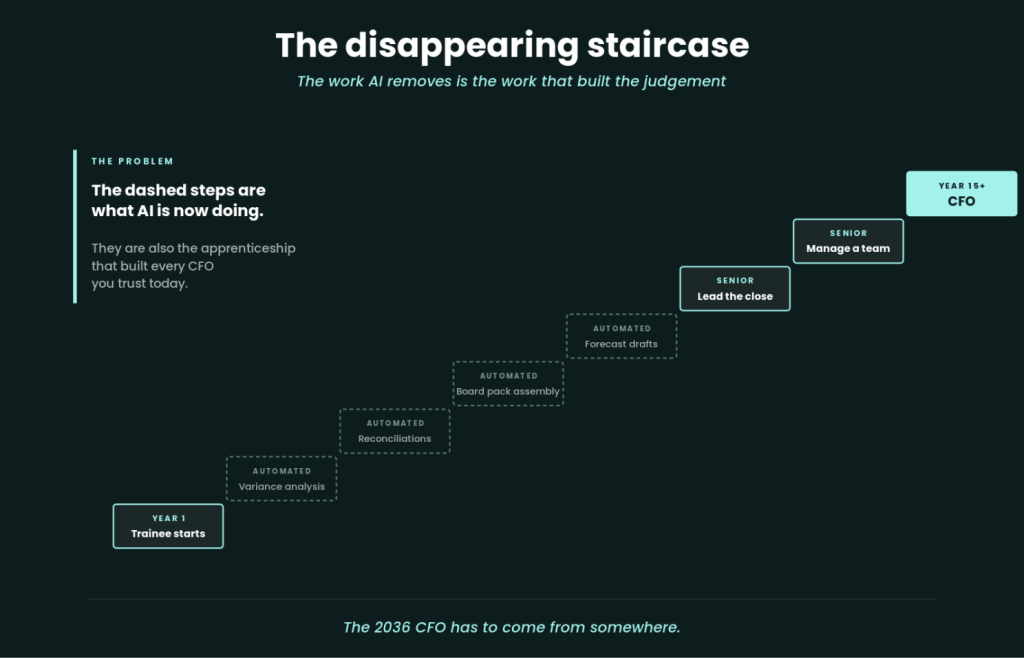
The staircase collapsed… then it got rebuilt. They’re different steps, but the same climb.
That was me talking, by the way. On a call last week with a finance transformation specialist, the conversation turned to the junior pipeline, and I heard myself making that case with more conviction than I expected. Which surprised me, because I’ve spent the past year arguing the opposite, loudly, in this newsletter among other places. AI is eroding the staircase that builds senior finance judgement, and somebody has to rebuild it on purpose.
Both of those things still feel true to me. But the weight has shifted towards hope, and I want to be straight about why, and about the two findings that stop me relaxing completely.
The optimist’s case
Look at what the previous waves actually did. The judgement didn’t die when the tool arrived. It moved up a level. The Excel generation stopped learning where every entry sat in the ledger and started learning which assumptions in a model would collapse under pressure, which is the judgement their bosses actually needed from them.
My hope is that the same move is happening again, and that the new first rung is already visible. The junior who spends their first two years validating agent output, running post-mortems when the model gets something wrong, building and improving the automations, isn’t doing less of an apprenticeship. They might be doing a better one. Checking a reconciliation an agent has drafted, and finding the thing it missed, is closer to what a senior reviewer actually does than keying the invoices ever was. You’d be starting your career on the version of the work that survives.
There’s early research pointing the same way. A Harvard Business School field experiment with BCG put GPT-4 in the hands of 758 consultants and found that, on tasks within the tool’s competence, they completed 12.2% more work, 25.1% faster, at higher quality, and the biggest gains went to the people furthest from mastery. An MIT study published in Science found the same pattern with writing tasks: the least experienced improved most, and the gap between stronger and weaker performers narrowed.
If that holds in finance, the tools don’t pull the staircase up behind them. They just lower the first step.
The two findings that stop me relaxing
The first is buried in that same Harvard study. On a task deliberately chosen to sit just outside the AI’s competence, people using the tool were 19% less likely to reach the right answer than people working without it. The machine is at its most dangerous exactly where it’s confidently wrong, and the consultants leaning on it couldn’t tell. So the new apprenticeship only works if juniors learn where the edge of the tool is, and you don’t learn the edge of a tool by trusting it.
The second is what the profession is saying about itself. ACCA and CA ANZ published research last month, built on a global survey of 1,600 finance professionals, and the dominant concern running through it wasn’t job displacement. It was trust. 67% report high concern about relying on AI-generated insights they can’t independently verify, and only 9% feel well prepared to deal with it. The same survey found 72% rate their own GenAI skills as low. The report calls it a trust deficit: finance leaders signing off on outputs from systems they can’t fully explain.
Put those two findings together and the risk in the hopeful story shows itself. Lifted output isn’t the same as built judgement. A junior producing senior-looking work with an agent underneath them hasn’t necessarily built anything of their own yet. A stairlift gets you up the stairs, but it doesn’t make you a climber.
Hope, with conditions
So my optimism is conditional, and the condition is design. We need to be intentional about this.
The previous staircases rebuilt themselves because the work still ran through human hands, whether anyone planned it that way or not. This time the hands are optional, so the new rung has to be chosen, paid for, and defended at a budget meeting where the pure cost case says delete it. For a mid-market CFO, I think that comes down to three decisions.
One. Keep a junior seat the spreadsheet says you could delete, and change what it does. The brief becomes validating agent output, building and improving the automations, and learning what good looks like from a senior who’s been given actual time to teach it. The seat costs the same, but the job is new.
Two. Make verification a taught skill rather than an absorbed one. The old staircase taught it by accident, through repetition. The new one has to teach it deliberately: structured reviews of agent output, honest post-mortems when the model gets it wrong, a senior walking a junior through why a number smelt off before anyone could prove it was. If that sounds like overhead, it’s the overhead we used to call experience.
Three. Hire for the climb, not the rung. The mid-level candidate who has built and broken agents, and can also read a room, is rarer than either skill on its own and getting more valuable by the quarter. When you find one, move quickly.
I’m aware of how it looks when someone who runs a search firm tells you to protect headcount, so treat the third one with whatever scepticism it deserves. The first two don’t earn me a penny, and I’d start there.
Where this leaves you
The optimists and the pessimists in this debate are arguing about the same staircase. Three previous waves say the profession adapts, and the early research says juniors gain more from these tools than anyone else. The same research says they can’t yet tell when the tool is wrong, and the profession admits it can’t either. All of that can be true at once.
A year of arguing the gloomy side has left me with one conviction I’d stake more on than any forecast: the difference between the two outcomes is whether anyone in your business decides, on purpose, that the first step gets built.
So… the question for your next team-shape conversation isn’t whether the bottom rung survives. It’s whether you’re building it, or hoping it forms on its own. I’m more hopeful than I was a year ago. I’d still rather be building.
If you’re working through what this means for the shape of your team over the next couple of years, drop me a note at [email protected]. It’s most of what we find ourselves talking about with CFOs at the moment, and the conversations that change my mind are usually the best ones.


