


Twelve months ago, James Orton’s business started losing money on purpose.
James is CFO of Kubus, a BGF-backed systems integration business with a plan to triple in size over three years. To build for that, it has doubled its headcount, from around 65 people to 130, and made two acquisitions, all while reinvesting its operating profit. That meant running operating losses and a net cash outflow, deliberately, for a year. When we recorded the latest episode of The Conscious Finance Podcast, he was right at the point of turning it back towards profit.
For part of that time, he told me, they’d knowingly let payroll run at the same level as gross margin each month. “It’s a pretty scary place to be, right?”
I open most CFO episodes by asking about the balancing act that defines the job right now. James said his was an easy one. On one side, being brave, believing in the investments and remembering that good investments take time. On the other, protecting the short term… cash, profit and credibility, because in a PE-backed business you have to be credible. The job is to manage and control the business while you back the growth story and, as he put it, “politely, not driving it off a cliff.”
That’s a lot to hold. You’ve got investors in one ear who want their return, a board in the other who’d quite like to stay out of loss-making territory, and a cash line heading the wrong way because you chose it. It’s very close to the nasty surprise most CFOs spend their careers trying to avoid. So how do you do it and keep everyone’s trust?
A better first word
There’s a reputation that follows finance around, and I put it to James fairly directly. A lot of FDs and CFOs get cast as the ‘computer says no’ person on the board. Many of the ones I speak to say accountancy trains you that way, to look for the downside, mitigate the risk and protect the business. Then you reach the FD or CFO seat and suddenly you’re expected to look at the upside and take risks you’ve never had to take before.
“It’s fair to say I’m not the most prudent CFO in the country,” he said. “I think that’s for sure.”
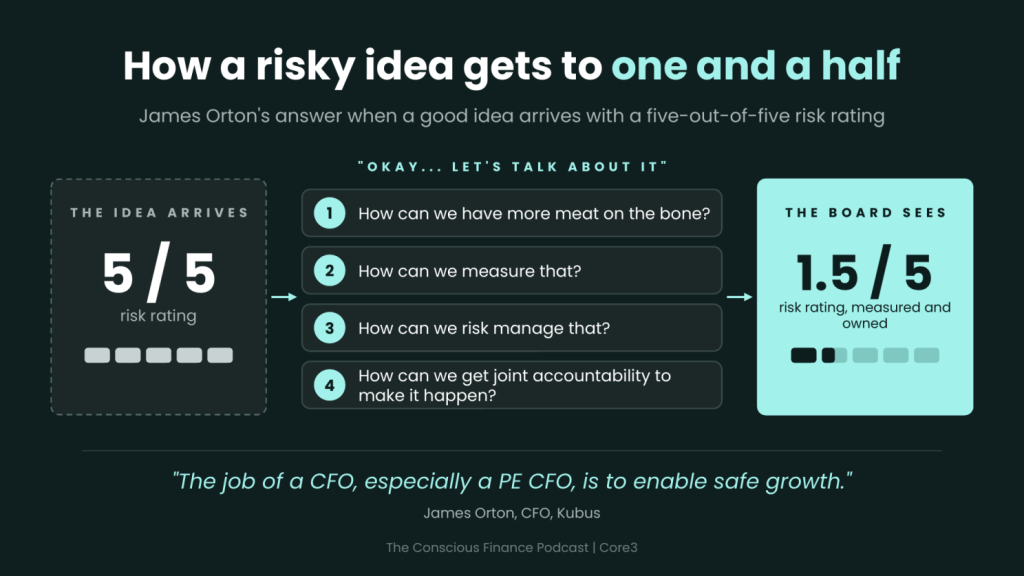
He doesn’t like saying no at the start of something, because you can kill a lot of good business by being the CFO who always does. He rarely says yes straight away either. His answer is ‘okay’… let’s talk about it, let’s understand it, let’s put some more meat on the bone. Then the real work starts. How do we measure it? How do we risk-manage it? How do we take a good idea with a five-out-of-five risk rating and get it down to one and a half, with joint accountability for making it happen?
“My personal view,” he said, “is the job of a CFO, especially a PE CFO, is to enable safe growth, not to just enable control. That’s not the job.”
Brave and risky are different words
When I said the weight of the seat probably explains why so many finance leaders lean towards caution, he drew a line between two words most of us use interchangeably.
“I’m sure the dictionary disagrees, but I think there’s a big difference between taking risks and being brave.”
Being brave, for James, means doing what you believe is right when it isn’t the easiest thing to do. He reeled off the easy options. It’s easy to say let’s not hire those five people. It’s easy to turn down the low-margin deal, even when it comes with a potential strategic partner attached. It’s easy not to buy the business, because integrating it is going to be really hard work.
What makes the brave version safe is the homework behind it, and then telling people what you’ve done. “Whilst I half smile when I say I’m definitely not the most prudent CFO in the world,” he said, “I’m definitely one of the most transparent.” He means something very practical by it. If they’re taking risks, people know they’re taking risks, the board included. The board knows where the money is going and where the return on it has or hasn’t turned up yet.
I put it back to him that if the upside and the downside are both on the table, there aren’t any surprises when something goes wrong… and it’s hard for anyone to blame you for something you told them could happen. He agreed, and then he told me the numbers never keep him awake at night.
Dust on the stock
“As a CFO, the numbers don’t ever keep me awake at night.”
He never lies awake wondering about this month’s profit or next week’s cash. A good CFO, he said, gets a feeling two or three months before something happens. The dust on the stock starts building up, and three or six months later you’re writing it off. There’s some disgruntlement in one part of the business. There’s some inefficiency over here.
I love that image, because anyone who’s walked round a stock room knows what it looks like. The dust is there on the shelf for anyone to see, and it won’t show up in a management account for months. By the time it does, it has a number attached and someone around the board table asking why nobody mentioned it.
That’s where his sleepless nights actually come from. The hard part is the stretch when things feel off and you can’t prove it yet. You can’t jump in with two feet as CFO because you think something might become a problem in three months’ time. You have to influence and work with the team, which takes judgement about how hard to push and when.
Picture a new FD who’s got banking covenants for the first time, tight headroom and a 13-week rolling forecast that’s just gone negative against the covenant. They’re going to have a sleepless night, and James understands why. For him, that’s the moment he breathes a sigh of relief.
“Okay, I’ve now got a challenge. I’ve got an understanding of the quantum of what now needs to happen. Now let’s build an action plan.”
Cash looks tight at Christmas, so you list the actions. Speak to these customers and these suppliers, push the business, maybe speak to the bank, speak to the board, then take ownership of delivering it. “It doesn’t sound that stressful, does it?” he said. “The stressful bit is the two months earlier.”
He was also clear that he’s been in businesses with cash and businesses without it. “It’s much nicer to be in ones with cash.” Hard to argue with that.
What this means in practice
- Swap your first ‘no’ for ‘okay’. The next time someone brings you an idea with a scary risk rating, ask what it would take to get it down to one and a half. What would you measure, what controls would you put round it, and who owns it with you? You can still say no at the end, with far better information.
- Write the downside down before you say yes. A short note to the board on where you’re investing, what return you expect and when, and what it looks like if the return is late. The conversation you’d least like to have in six months gets a lot easier when it’s already on record.
- Go looking for the dust. Every warning sign James described came from the business itself, from the stock on the shelves to the mood in one part of the team. You only see them if you’re close enough to notice, and part two has more on how he makes sure he is.
- If you’re hiring a CFO for a PE-backed growth plan, test how they say ‘okay’. In my experience a lot of interviews test for prudence, because it’s the easier thing to probe. Hand the candidate a good idea with a high risk rating and ask them to talk you through their first week with it. You’ll see how they de-risk it, how they bring people with them and how they’d tell the board, which is most of the job James was describing.
Where this leaves you
James has spent a year doing the thing most finance leaders are trained to avoid, and his board has known where the money was going the whole time. The bravery and the transparency turned out to be one habit. A risk everyone saw coming doesn’t land as a surprise, so the board keeps backing the next brave call.
The CFO a board trusts with the bold decision is usually the one who’s never surprised it.
Which raises the question for part two. If keeping the board free of surprises is what makes bravery possible, what does that look like on the third working day of the month? James has a very clear answer, and it involves six bullet points, a lawnmower and a mother-in-law.
• • •
The full conversation with James is out now on The Conscious Finance Podcast. It includes how an 18-year-old who joined a Big Four firm ended up running finance in a PE-backed business without ever posting a journal, and what he looks for before buying a business, from someone who reckons he’s done somewhere between 50 and 100 deals.
Listen now – https://linktr.ee/TheConsciousFinancePodcast
Or watch here…
Thanks for reading,
Leo


