


The first step just moved halfway up
“Are they actually going to be able to be trained and move forward?”
A CFO asked me that recently, when we were talking about what his finance team looks like once AI takes on more of the mechanical work. “It’s always the issue, right?” he said, and he’s not wrong.
When I first started writing about this, I was almost saying it’s the disappearing staircase, where the first few steps have gone. (I’ve still got the diagram!)
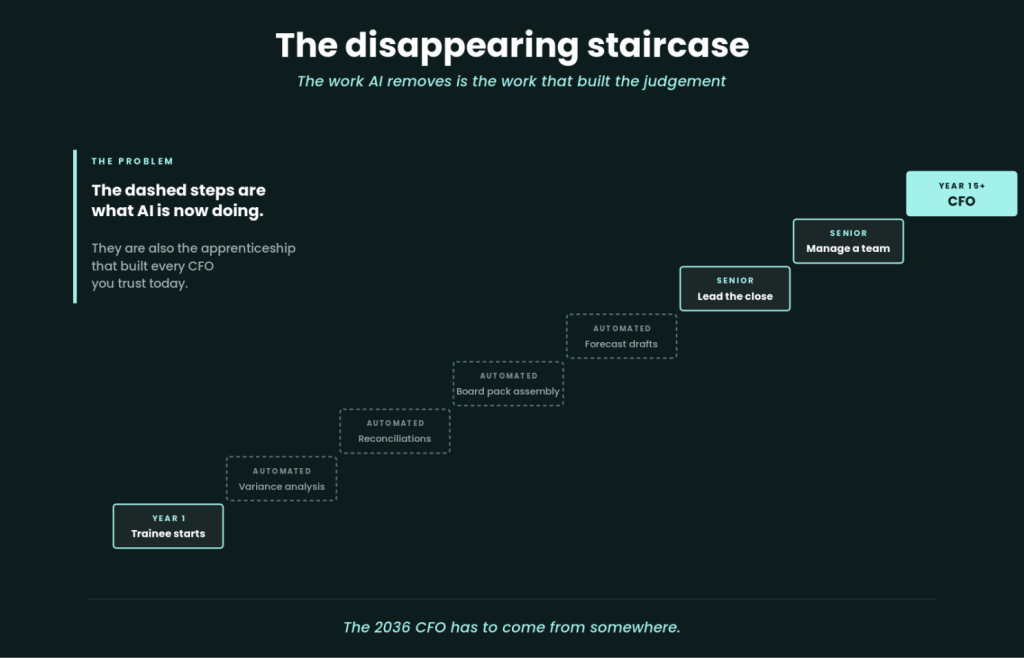
The old staircase to CFO was years of month end. Thousands of hours in a spreadsheet. Tedious, but that’s how you built the judgement to know what good looks like.
So if AI takes those early steps away, where do people learn the job? Take the juniors out now and in 5 to 10 years that whole layer simply isn’t there. Try to hire an FC in 5 years’ time and the talent pool won’t be there either… the price of good Financial Controllers goes through the roof, and the money you were trying to save with AI has gone out the window.
An economist I was planning an event with recently had the same worry, and they weren’t even talking about finance: “I still need a 10-year engineer, but I don’t need the junior ones. But how do I get a 10-year engineer if I don’t hire any junior ones?”
For a while, I was a bit worried too. Where are people going to learn the job if the agentic layer is doing all of the do?
What’s changed
One of my podcast guests made a really interesting point on this… he said the judgement can actually get built way quicker. He called it “everyone’s a manager”.
A CFO client said something similar from his own experience. Seeing the logic of the prompt had been phenomenal for building his understanding, and in his words, “the judgement and the learning is just accelerated.”
When AI gives you an output, it gives you the commentary, the why, and how it got there, which playing around with Excel never gave you. It’s like having a coach in your pocket, giving you commentary on every single thing you’re doing.
So I think the first step on the staircase is now about halfway up…
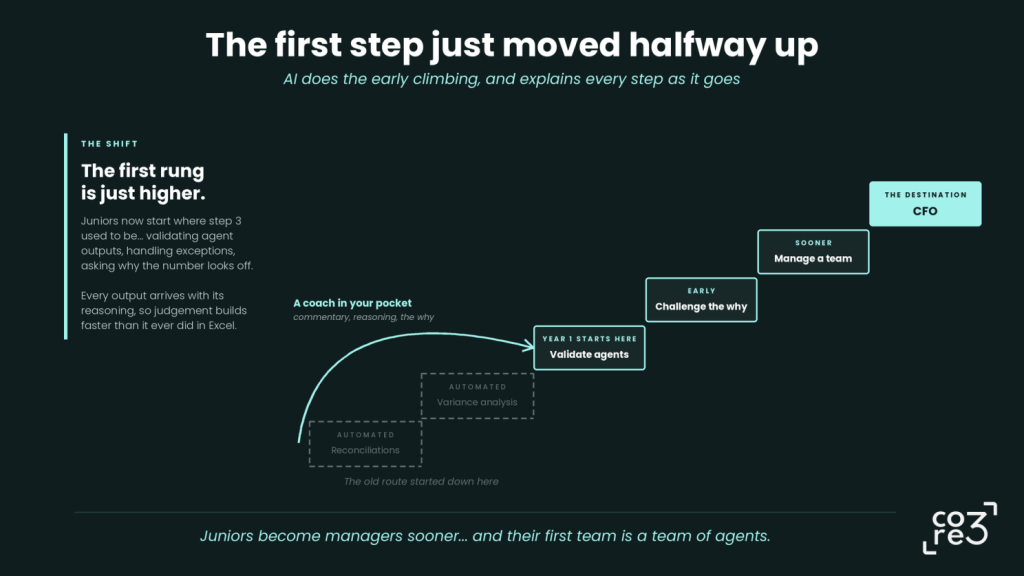
Juniors almost become managers quite quickly, because they’re managing the outputs of the agents… reviewing them and handling the exceptions. I think that’s almost like how the judgement gets rebuilt.
We’ve been here before. When the calculator arrived, and then Excel, people were up in arms… how will anyone learn double entry? Then cloud ERP came along, one click, and how would they ever learn? The judgement still got built, it just got built in a different way.
Who does well on the new first step
The juniors who do well are problem solvers, inquisitive enough to spot the thing that doesn’t quite look right.
They’re the ones who look at an agent’s output and say “hang on, let me check that against what I can actually see in the ledger.”
What this means in practice
Over 1,200 finance leaders have joined our AI in Finance workshops since January, and we survey all of them. Only 3% have actually got AI into workflows in their finance team. No one’s the finished article yet. It’s just too early.
If there’s a junior finance hire anywhere in your plans, here are 4 things worth doing before you write the job spec…
- Think twice before going like for like. So many people would just replace the assistant accountant who’s leaving with another assistant accountant, and then in 2 years that role is redundant. Dusting off the job spec from 3 years ago isn’t the right way of thinking when the world is changing this quickly. Think ‘Finance Analyst’ rather than ‘Finance Assistant’.
- Write the new work into the job. Put reviewing the agents’ outputs and handling the exceptions into the job description, so the role is built for how the work runs now.
- Test for inquisitiveness. Leave them in a room with a task, say they can use as much or as little AI as they want, and see what they do.
- Give your FC the coaching job. With less manual work and more time on their hands, it becomes much more of a coaching and mentoring role, helping the next generation understand what good looks like. And when you hire a finance manager to grow into an FC, look for that potential too.
Our advice to clients is to coach and develop the team you’ve got before cutting and replacing.
Where this leaves you
I’m ever the optimist on this one. I think the next generation of CFOs will just cut their teeth in a different place.
So it might be worth asking yourself questions like…
- What does your finance team look like in 3 to 5 years?
- Who’s in it?
- What are they doing on a Tuesday?
Im always happy to have my brain picked if you’d like to discuss what the future looks like for your finance team. Feel free to reach out: [email protected], or message me on Linkedin.
Thanks for reading,
Leo


